Reduce virgin raw-material demand. Use existing mixing assets. Engineer the performance you actually need.
The recycling benefit matters. But management attention starts with cost, sourcing resilience and strategic timing.
Estimate why one controlled industrial trial can deserve board-level attention.
Illustrative preliminary range from selected internal comparisons. Not a guarantee. Customer-specific formulation, energy, labour, throughput and quality-control effects require validation.
If the target performance can be achieved at a lower cost per tonne, the strategic value starts before carbon credits, subsidies or ESG benefits are counted.
The saving comes first.RUBREG DIRECT is designed to integrate functional activation and target compounding into the customer’s conventional mixing route.
Tyre-derived powder, factory rubber waste or qualified legacy material plus RTA and formulation components.
Activation and target compounding occur within the conventional mixing route.
A formulation engineered to the mechanical and processing properties required by the application.
The public site shows enough to establish credibility. Full technical evidence remains for the NDA / due-diligence stage.
DIK prepared and cured a fresh reference compound, produced ground rubber, evaluated treated material returned after activation, added a curing system and produced new vulcanized test specimens.
DIK also stated that the treated materials did not match the fresh-compound properties and identified partial substitution as a possible use. Methods included DIN 53529-3, DIN 53505, DIN 53504 and ISO 34.
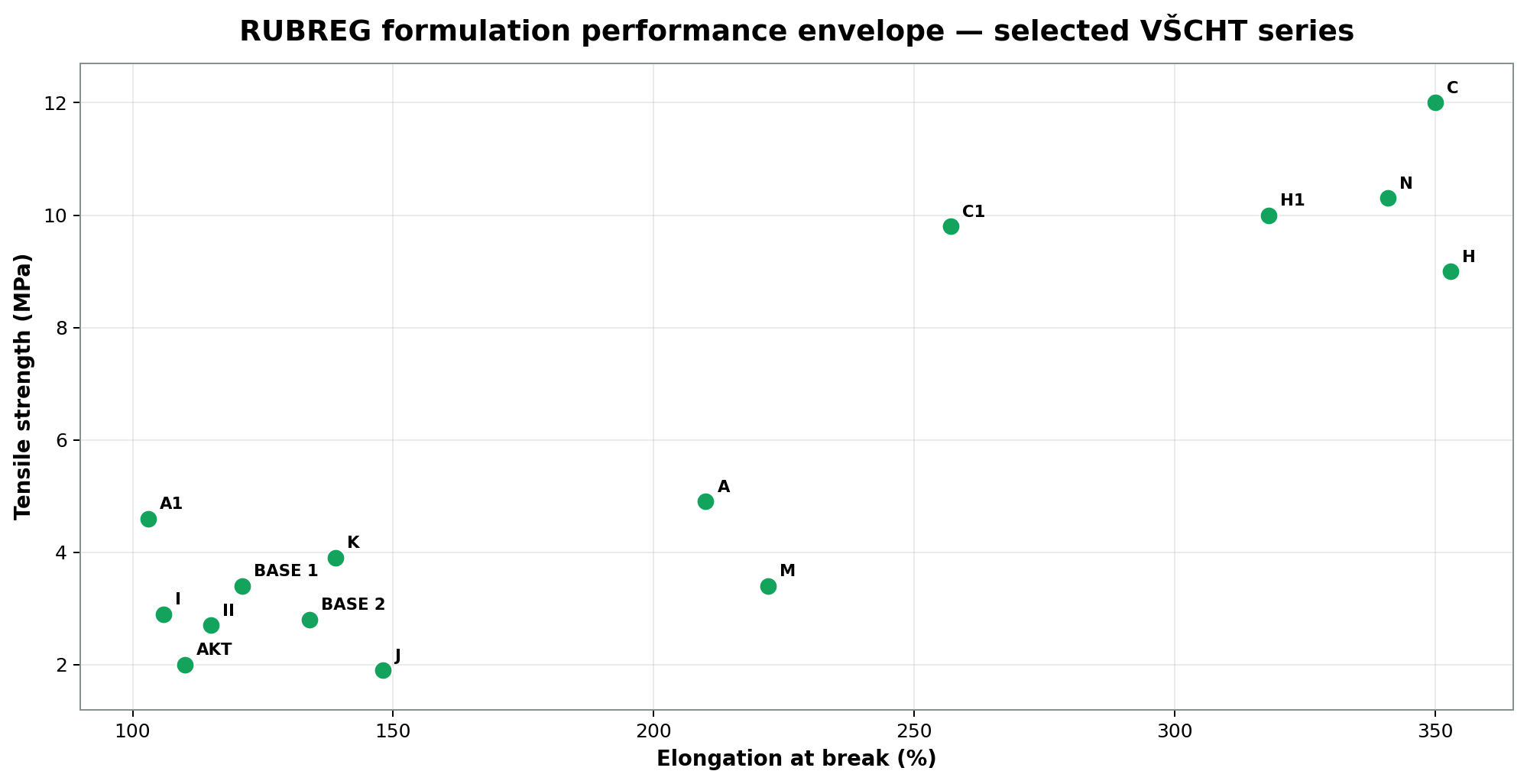
Multiple formulations and repeated specimens were evaluated across tensile strength, elongation, modulus, tear / structural strength, Shore A hardness and abrasion.
The point is not one “best” recipe. The point is controllable formulation across different target property profiles.
RUBREG is developed against the required performance envelope — not against a closed list of end products.
Stops, pads, guards, selected seals, anti-vibration and protection components.
Mats, tiles, sheets, anti-slip, damping and protective products.
Stable and yard mats, machine protection, logistics products and selected wheels.
Soles, heels, sheets and selected extruded profiles.
Isolation, damping, impact and protective components.
Precompounds for selected tyre-part development and customer validation.
The technology can create a higher-value route for qualified rubber powder streams without positioning RUBREG as a recycling company.
Qualified tyre-derived powder can enter application-specific compound development.
Selected clean production waste can become a controlled secondary raw material.
Historic rubber stocks may become recoverable raw material after excavation, sorting, cleaning and grinding.
Reduced demand for virgin NR/SBR and selected high-cost ingredients.
Potentially fewer unit operations and no dedicated RUBREG DIRECT activation line.
Avoided upstream emissions may create additional value after robust methodology and verification.
RUBREG is evaluating selected strategic, regional and application-specific access structures. The first serious step is not a purchase order. It is a confidential compound-economics and performance assessment.
Detailed RTA composition, critical process settings, full formulations and technical evidence remain restricted until the appropriate NDA / due-diligence stage.